Water Line Repair & Replacement
Not Sure if Your Water Line Can Be Repaired or Needs Replacing?
The water line is the pipe that carries water from the meter into your home. When it starts to fail, the signs are often quiet at first: a pressure drop at the faucets, a damp patch near the meter, or a water bill that keeps climbing.
This guide explains how water lines fail, when a repair is enough, and when replacement makes more sense. Whether you are looking at water line repair in North Atlanta or trying to understand why the pressure has dropped, start here.
Starting Point
Is It the Water Line, or Something Inside the House?
Some people have a clear sign: water pooling near the meter, a sinkhole starting to form in the yard, or the main shutoff outside failing to close all the way.
Others just notice a change. The shower pressure is weaker than it used to be, the water looks discolored when you first turn it on, or there is a sound of running water that no fixture explains.
The first step is working out whether the problem is in the line to the house or in the plumbing inside it. Common questions include:
- Why has the water pressure dropped throughout the house?
- Is the water line the homeowner's responsibility or the city's?
- What does a wet patch in the yard near the meter mean?
- Why is the water rusty or discolored when it first comes out?
- Can a leaking water line be repaired without digging?
- How do I know if the line should be replaced instead of patched?
- What material is an older water line likely made from?
- Is it safe to keep the water on while it is leaking?
The most useful test is the main shutoff. Close the valve at the meter and check whether the meter still moves. If it does, water is escaping between the meter and the house, which points to the water line rather than anything inside.
Diagnosis
The Three Kinds of Water Line Problems
Most water line problems fall into one of three categories, and each one is handled a different way.
Leaks in the line
A crack, a failed joint, or a worn fitting letting water escape underground. Pressure drops, the meter keeps moving, and water may surface in the yard.
Corrosion and buildup
Older steel or galvanized lines rust from the inside out. Flow slows, water discolors, and the pipe gets weaker until it finally gives way.
Damaged or collapsed pipe
Tree roots, settling soil, or an old pipe that has cracked or crushed. A repair cannot fix a pipe that has lost its shape, so replacement is usually the real answer.
Patching a corroded or collapsed line is how the same leak comes back a few months later. Knowing which type you have is what decides whether a repair makes sense.
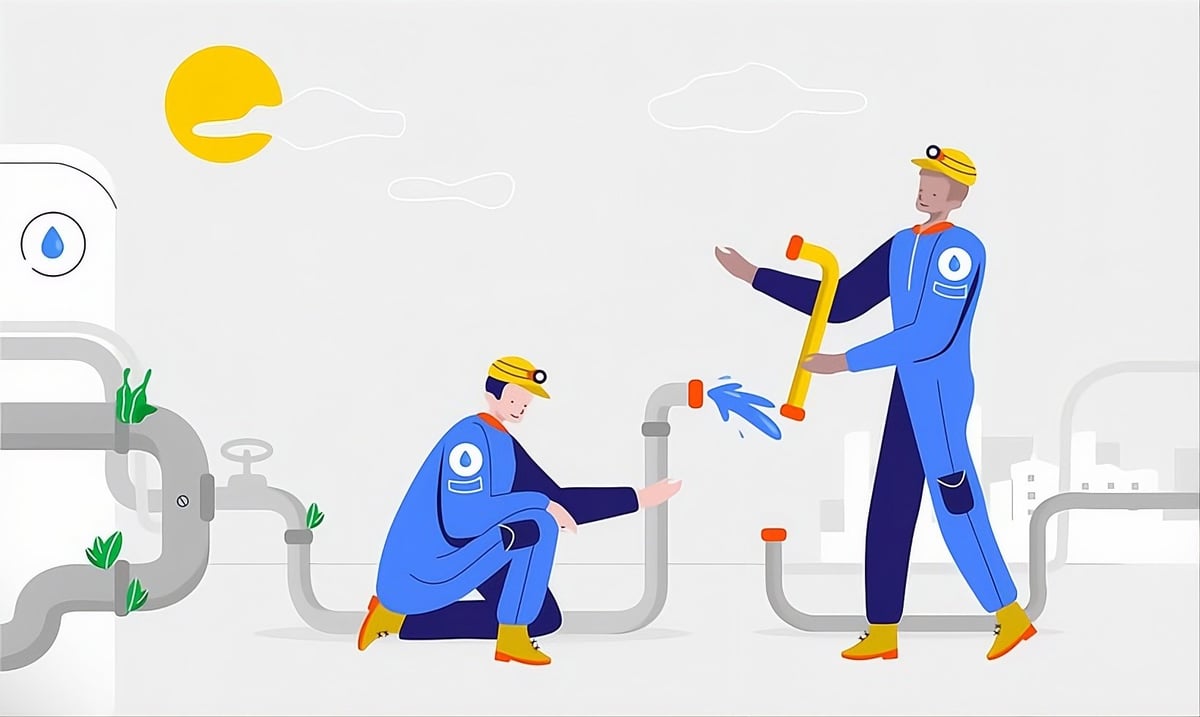
By Symptom
Common Signs and What They Usually Mean
Low Pressure at Every Faucet
When the pressure drops throughout the house, the restriction is usually before the fixtures, which means the supply line. A slow loss of pressure over time points to corrosion; a sudden drop points to a leak.
Water in the Yard Near the Meter
A damp or sunken patch between the meter and the house is one of the clearest signs of a leaking water line. It can also show as an unusually green strip of grass over the pipe route.
Discolored Water or Metallic Taste
Rusty or brown water, especially when first turned on, often comes from the inside of an older line. Sediment and rust are loosening from the pipe wall, which usually means the line is nearing the end of its life.
A Meter That Never Stops
If the meter keeps turning with every fixture off and the main valve closed, water is moving somewhere it should not be. That is the clearest signal a professional inspection is worth doing right away.
Before You Call
Can You Handle It Yourself?
Some things are reasonable. Checking the meter with everything shut off, knowing where your main valve is, and replacing a failed supply line under a sink are all jobs many homeowners can manage.
Where it gets more involved is underground. Digging up a water line without knowing what is down there, or how deep the pipe runs, can cause more damage than it fixes.
Worth Being Careful With
Before any digging, utilities need to be marked. Hitting a gas, electric, or fiber line while looking for a water line is a real risk, and the cost of getting it wrong goes well beyond the plumbing.
If the leak is active and water is running toward the house or across a walkway, shut off the main valve first, then call. That one step limits the damage while you wait.
Professional Help
When It Makes Sense to Call a Plumber
Professional water line service is worth it when you need:
- Leak Location
- Water Line Repair
- Water Line Replacement
- Pressure Testing
- Main Valve Replacement
- Pipe Material Upgrades
- Utility Coordination
- Yard Restoration Planning
This is especially useful when the meter never stops, when water is surfacing outside, or when the pressure has dropped throughout the house and a fixture-level fix has not helped.

Next Step
Getting Your Water Line Repaired
Once the problem is located, the plan is usually clear. A plumber isolates the house, confirms where the line is failing, explains whether a repair or replacement is the right call, and completes the work cleanly.
Super Pro Plumbing handles water line repair and replacement for homeowners throughout North Atlanta. Along with leaks, pressure problems, and aging pipe, we serve homeowners in Cumming, Alpharetta, Roswell, Suwanee, Johns Creek, Lawrenceville, Dacula, Duluth, Norcross, Snellville, Canton, Ball Ground, Marietta, Crabapple, and Milton. As a local plumbing company in North Atlanta, we understand how the homes and water lines in this area are built.
Whether your meter never stops or your pressure has quietly faded, we can find the source, explain what is practical, and complete the work cleanly.
Super Pro Plumbing|6010 Bethelview Rd Ste 110, Cumming, GA 30040|(678) 607-8801
Frequently Asked Questions
Water Line Questions
The clearest test is the meter. With every fixture off and the main valve at the meter closed, a meter that still moves means water is escaping between the meter and the house. Damp patches or a sunken strip in the yard back that up.
In most cases the line from the meter to the house is the homeowner's responsibility, while the meter and the line beyond it belong to the utility. If you are unsure, the utility can tell you where their responsibility ends.
Sometimes. A localized leak might be repaired with a targeted excavation. For a line that has failed along its length, a replacement may be needed, and some of those can be done with less digging using modern methods.
Copper and newer materials typically last decades, while older galvanized steel lines can corrode much sooner depending on soil and water chemistry. Discolored water and falling pressure are the usual signs a line is reaching the end.
A sudden drop usually points to a new leak or a partially closed valve. A gradual decline over months or years points to corrosion building inside the pipe. The meter and a pressure check tell you which.
We serve North Atlanta and surrounding communities including Cumming, Alpharetta, Roswell, Suwanee, Johns Creek, Lawrenceville, Dacula, Duluth, Norcross, Snellville, Canton, Ball Ground, Marietta, Crabapple, and Milton. If you are not sure whether you are in our service area, give us a call.